Gloriously Broken: Why Britain's New Post-Punk Wave Is Falling in Love With Vinyl's Flaws
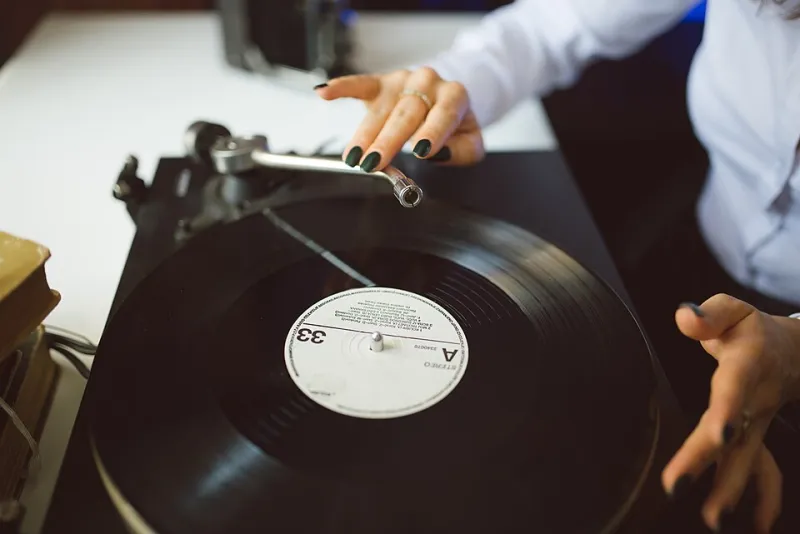
Photo: Shixart1985, CC BY 2.0, via Wikimedia Commons
There's a moment in a recording studio when a producer will traditionally reach for the tools that smooth everything out. The noise gate that silences the room tone. The limiter that tames the peaks. The digital processing that makes a guitar sound like it was played in a vacuum. Clean. Perfect. Ready for streaming.
But in a growing number of sessions happening in studios across Manchester, Bristol, Sheffield, and South London, producers are doing the opposite. They're leaving the room in. They're letting the tape breathe. And when the record eventually gets pressed, they're not just accepting the surface noise and crackle — they're actively designing for it.
Welcome to what some are quietly calling the "beautiful damage" school of British recording.
Against the Algorithm
To understand why this is happening, you have to understand what it's a reaction against. The dominant sound of contemporary pop and much mainstream indie is one of extraordinary cleanliness. Vocals are pitch-corrected to the nanometre. Drums are quantised to a grid. The overall effect is music that sounds less like a performance and more like a simulation of one.
For a certain strain of British post-punk artist, this is not just aesthetically uninteresting — it's actively dishonest. "Music is supposed to sound like humans made it," says Rosa Hennessy, vocalist and guitarist with Sheffield four-piece Bitter Seam, whose debut LP was recorded to two-inch tape and deliberately mastered with vinyl's limitations in mind. "When everything is perfect, it doesn't feel like anything. It's like looking at a digitally retouched photograph. Technically flawless, emotionally empty."
Bitter Seam's approach to their record was almost confrontational in its commitment to imperfection. They recorded live in the room, minimal overdubs, and asked their mastering engineer to leave in the tape hiss, the low-frequency rumble, the natural decay of the room. When pressed to vinyl, the result sounds like it was made by people who exist in physical space — which, of course, it was.
The Producer's Toolkit for Imperfection
The technical side of this is more involved than simply pressing record and walking away. Getting vinyl's characteristics to feel intentional rather than accidental requires a very specific kind of craft.
Producer and engineer Callum Dray, who works out of a studio in Salford and has worked with several acts at the forefront of this movement, explains the process. "There's a difference between something sounding rough because nobody cared, and something sounding rough because every decision was made to serve that quality," he says. "We're talking about gain staging, microphone placement, the choice of preamps, the way you hit tape. All of it is in service of a sound that feels alive."
Callum often uses what he calls a "vinyl response" approach to mixing — essentially, making decisions during the mix that anticipate how a record will behave once it's cut. "Vinyl compresses certain frequencies, it has its own noise floor, it responds differently to different volume levels across the frequency range. If you understand those characteristics intimately, you can actually use them creatively rather than just fighting them."
This might mean deliberately boosting frequencies that will interact interestingly with the pressing process, or leaving in low-end rumble that would normally be filtered out. It's a philosophy of working with the format rather than against it.
Surface Noise as Texture
For some artists, the appeal goes beyond technical craft into something more philosophical. The crackle and pop of a well-played record has become, for this generation, a kind of sonic shorthand for authenticity — a signal that what you're hearing has a history, has been handled, has existed in the world.
Bristol-based duo Pale Static, whose music sits somewhere between Wire-era post-punk and contemporary shoegaze, have spoken openly about incorporating surface noise as a compositional element. On their recent EP, the opening track begins with several seconds of pure vinyl hiss before a guitar chord arrives — a deliberate choice that frames everything that follows as something found rather than fabricated.
"There's an archaeology to vinyl that you don't get with digital," says the duo's Jess Carmichael. "Every pop and crackle is evidence of time passing, of the record being played and loved and passed around. We wanted our music to feel like it already had that history, even on first listen."
It's a striking inversion of the usual logic. Where most artists want their debut record to sound fresh and new, Pale Static wanted theirs to sound lived-in from the moment it left the pressing plant.
The Cultural Context
This isn't happening in a vacuum. The embrace of vinyl's imperfections by contemporary British acts is part of a broader cultural pushback against the relentless optimisation that defines so much of modern life — algorithmically curated feeds, frictionless digital experiences, the smoothing-away of anything rough or unexpected.
In that context, a record that pops and hisses and breathes is almost a political act. It insists on its own materiality. It refuses to be convenient.
"People are tired of perfect," says Callum Dray simply. "They want to feel something real. And for a lot of listeners, especially younger ones who've grown up entirely in digital spaces, that crackle is the sound of real."
The irony, of course, is that achieving this sound requires enormous technical skill and careful intention. The beautiful damage is very deliberately created. But perhaps that's the point — that authenticity, in the end, is always a craft.
What This Means for Live Performance
There's a natural bridge between this studio philosophy and the live stage. Bands who have committed to this sonic aesthetic tend to perform with the same confrontational honesty — loud, imprecise in the best possible way, prioritising feel over fidelity.
When Bitter Seam play live, Rosa says, the goal is to recreate the experience of the record rather than a polished version of it. "We want people who've heard the album to feel like the live show is the same world. The same roughness, the same energy. The vinyl sound isn't a studio affectation — it's actually who we are."
That alignment between recorded and live identity is perhaps the most compelling aspect of this whole movement. The record doesn't present a cleaned-up version of the band for public consumption. It presents the band as they actually are — flaws, crackle, and all.
In a music landscape that often feels like it's trying to sand away every rough edge, that's genuinely radical. And it sounds absolutely brilliant.