Haunted Halls: What Britain's Lost Music Venues Can Still Teach Us About Sound
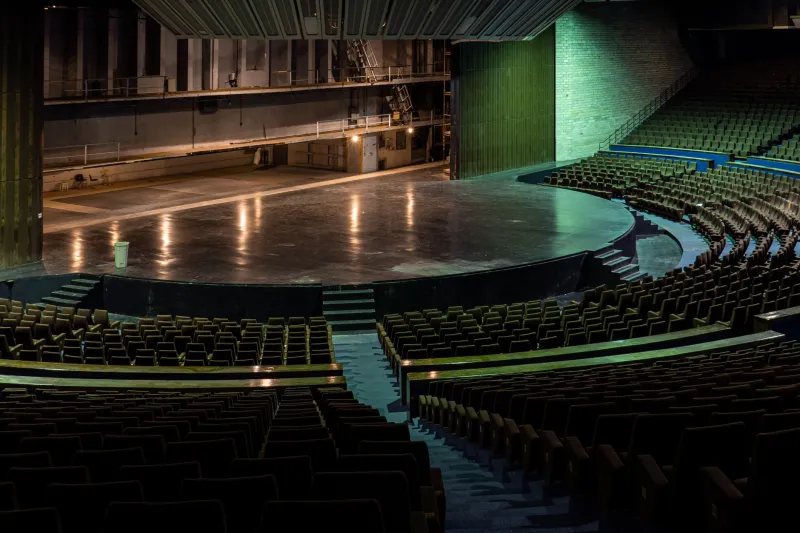
The building doesn't look like much from the outside. It's a tyre fitting centre now, a flat-roofed unit on an unremarkable stretch of road in a West Midlands town. But step through the right door, into the back section where the old stage once stood, and something odd happens. Clap your hands. The sound comes back to you in a way that doesn't quite match the room you're standing in — a ghost of different geometry, a remnant of plaster curves and timber battens that once shaped music into something extraordinary.
This is what acoustic historians call a "residual signature." The room has changed, but the room hasn't entirely forgotten what it was.
The Venues That Shaped the Vinyl Era
Britain's musical geography is littered with venues that no longer exist as venues. Ballrooms converted to bingo halls, theatres turned into flats, purpose-built concert spaces swallowed by supermarkets or simply left to rot. Most of the conversation around these losses focuses on cultural heritage — the gigs that happened, the artists who played, the communities that gathered. Less often do we talk about what was acoustically lost when those rooms changed hands.
During the vinyl era — roughly the 1950s through to the early 1990s, when records were the dominant medium — venues were often designed, or at least adapted, with a particular relationship to sound in mind. Not the sound of amplified modern PA systems, but a more intimate, room-filling quality: the kind that translated well to a microphone and, ultimately, to the groove of a record.
"There was an intuitive understanding of acoustics in a lot of those spaces," explains Dr. Patricia Hollis, an acoustic consultant who has spent years documenting defunct UK music venues. "The builders didn't always have the science, but they had experience. They knew what a good-sounding room felt like, and they built accordingly."
Hollis has visited more than forty former venues across England, Scotland, and Wales in the past decade, taking acoustic measurements where possible and interviewing people who worked in or attended them. What she's found is a consistent set of design choices that modern venue builders have largely abandoned — and that, she argues, modern audiences are quietly missing.
Curved Walls and Diffusion
One of the most common features of well-preserved former concert halls is curved or angled wall surfaces. In an era before sophisticated digital sound processing, these curves served a practical purpose: they scattered sound energy evenly around the room, preventing the "hot spots" and "dead zones" that plague many modern rectangular spaces.
"The ballrooms were particularly good at this," says Hollis. "You'd have a curved ceiling, sometimes a domed section over the dance floor, tiered seating with angled faces. All of it was doing acoustic work, even if nobody called it that."
In several of the repurposed spaces she's visited, these original surfaces remain — hidden behind plasterboard, above suspended ceilings, or simply overlooked by the building's new owners. She recalls one former dance hall in Lancashire, now a furniture showroom, where lifting a section of the dropped ceiling revealed the original curved plaster cornice entirely intact. "The acoustic properties were still there. The room was still doing what it was designed to do. Nobody had thought to ask."
What the Vinyl Pressing Tells Us
There's a specific reason to care about how these rooms sounded during the vinyl era: we have the records. Thousands of live recordings — official releases, radio broadcasts, and yes, bootlegs — captured the acoustics of venues that no longer exist. With the right analytical tools, those recordings can serve as acoustic blueprints.
A small number of researchers and sound engineers are beginning to do exactly this. By analysing the reverb characteristics, frequency response, and room modes audible on vintage live recordings, they're building acoustic profiles of rooms that have been demolished or converted. It's forensic work — painstaking, imperfect, and genuinely exciting.
"If you have a good-quality recording from a particular venue, you can extract a lot of information about the room," explains sound engineer Marcus Webb, who has been involved in several such projects. "The way the reverb decays, the frequency content of that decay — it tells you about the room's size, its surface materials, its geometry. You're essentially reverse-engineering the architecture from the sound."
Webb has worked on profiles of three former UK venues, including a much-loved Manchester club that closed in the 1990s. His goal isn't nostalgia — it's application. "If we understand what made those rooms sound good, we can apply those principles to new builds. We don't have to keep making the same mistakes."
The Modern Venue Problem
Those mistakes, many in the industry agree, are considerable. The economics of modern venue construction tend to prioritise capacity, flexibility, and low maintenance over acoustic quality. Hard, flat walls are cheap. Proper diffusion is expensive. PA technology has advanced to the point where many promoters assume it can compensate for any room — and it often can, to a degree, but the compensation is never quite the same as a well-designed space.
"There's a reason people talk about certain old venues the way they do," says one independent promoter who has worked across the UK for two decades. "It wasn't just sentiment. Those rooms genuinely sounded different. The music landed differently."
For vinyl enthusiasts, this has a particular resonance. The warmth and depth that listeners prize in a well-cut record — the sense of a real space, of air around instruments, of a performance happening somewhere — is precisely what good room acoustics provide. A venue that sounds right is a venue that sounds like a record should.
Learning From What's Left
The case for taking Britain's acoustic heritage seriously isn't just a nostalgic one. It's practical. As the UK's grassroots venue sector faces ongoing pressure from rising costs and development, the argument that these spaces have irreplaceable sonic value — value that can inform future design — gives preservationists a new angle.
Dr. Hollis is cautiously optimistic. "There's more interest in this than there was five years ago," she says. "Promoters are asking better questions. Architects are listening. The vinyl revival has helped, actually — it's reminded people that the way a room sounds is worth caring about."
Back in the tyre fitting centre, standing where a stage once stood, the clap test still yields its quiet revelation. The room remembers. The question is whether anyone's paying enough attention to learn what it's trying to say.